Fulcrum Ruminations

Saturday, July 19, 2008

It's Been Such a Long Time . . . It's Been Such a Very Long Time

Quite a while since the last post. Well over a month. Much has happened.


Barack Obama is of course the presumptive Democratic nominee for President. I believe he will win. McCain has a good record of service but he feels old and tired. His moment was 2000, not 2008. Obama is putting out a message of "change" which, even tho it's not actually defined very well, is bringing people into his camp. And since he is relatively young and not fully assimilated by the Washington political culture, he may be able to deliver. We'll see in November.


Oil prices have skyrocketed. The economy, already battered by the housing industry implosion, is looking like it's headed towards a recession. President Bush announced the opening of formerly-restricted areas to oil drilling and that's having a somewhat calming effect on prices, at least for the moment. Realistically, the only long-term fix to this problem is to move off of the oil standard entirely. There are measures that can be taken, and we're seeing some stuff already happening as the market adjusts itself. The big American car manufacturers are scaling back or ceasing production of oversized, inefficient vehicles like SUVs and there are plans for more hybrids. Small cars are coming into demand again as short-sighted American consumers finally have reason to think about fuel efficiency. At least one manufacturer has announced a hydrogen-powered car for near-future production.


Of course, the more government interferes with the market, the worse things will get. One has only to look at the ethanol subisdy business to see how easily good intentions can fall victim to the Law of Unintended Consequences.


The situation in Iraq continues to improve. Only the most foaming-at-the-mouth of the reality-impaired can now deny the success of the "surge" strategy. Afghanistan, meanwhile, is not going so well. Too many resources being directed to the Iraqi theater means not enough is being done in Afghanistan. Still, the situation remains controllable. One hopes that the next President doesn't suffer an attack of extreme foolishness leading to a precipitous action like a sudden withdrawal from Iraq before things are sufficiently stable.


The recent Heller decision by the Supreme Court, altho flawed, nevertheless established the Second Amendment as an individual right. Of course, this was patently obvious to anyone with more than a sixth-grade command of the english language all along, but it's nice to have it made official. The DC government, as is the habit of entrenched liberals, is trying its best to ignore or circumvent the court's decision. I forsee several more legal challenges to DC's grossly unconstitutional gun laws in the near future. Meanwhile, it seems likely that several other cities with such rubbish on their books will also see their attempts to trample the rights of their citizens challenged on the basis of Heller.


The FISA legislation was passed by Congress. This of course is damaging to our freedoms, being yet another short-sighted attempt to provide security at the cost of essential liberties, and we all know the famous quote regarding such things. I believe it's time to show Congress that We The People aren't going to tolerate their nonsense any longer and vote the lot of them out of office. However, I have no realistic expectation that this will happen. There are too many knee-jerk voters out there who would vote for Satan so long as old Scratch had the right letter in front of his name. And everyone always seems to think that, altho Congress is doing a poor job, their own guy is just fine and they keep sending him back.


No profound insights this time, I'm afraid. Just some random thoughts and observations.

Labels: , , , , , , , , ,

Wednesday, March 19, 2008

What Good Is The Truth If Nobody Knows It?

I'm not one to read or rely upon The Weekly Standard for my news, but when someone gets it right, they get it right. There's a piece in the 24 March issue called Saddam's Dangerous Friends by Stephen F. Hayes which lays out a somewhat more complete picture of the recent Pentagon report on the connection between the Saddam Hussein regime and al Qaeda than you'll find in the mainstream media. The report, titled Iraqi Perspectives Project: Saddam and Terrorism: Emerging Insights from Captured Iraqi Documents, is derived from analysis of some 600,000 documents seized in Iraq since the beginning of the war.


Not surprisingly, the left-leaning media got it wrong. They seem to have seized on some partial quotes from the report's executive summary which appeared to support the "Bush Lied" meme running rampant in the reality-impaired community and pretty much ignored the rest of the thing, which actually paints a quite different picture. Saddam's regime was quietly supporting various and sundry terrorist groups, some of which were offshoots of al Qaeda and some of which were allied with it. That's a wee bit different than the glib "No smoking gun!" headline so quickly and easily swallowed by those who already leaned that way, isn't it?


Anyway, read the piece and judge for yourself. I found it interesting and thought it should get wider attention.

Labels: , , , , , , , , , ,

Monday, January 07, 2008

A Light Fades Out

A poignant final post from milblogger Andrew Olmsted, killed in Iraq. A good man, gone now, leaving a void that can't be filled.

Labels: , , ,

Friday, December 28, 2007

Iraq In Review

The National Review Online, that is. I saw this link on Little Green Footballs today and found it interesting. It's often useful to consider something like the course of public reaction over the timespan of a given event, and this piece by Victor Davis Hanson sums up the public reaction to the vagaries of the Iraq war quite nicely.

Labels: , , ,

Wednesday, December 12, 2007

Time Passages

Yes, now it's December and I still haven't posted anything.

When I started this blog, it was because I was dismayed at the hate and anger seen in blogs on the fringes of the political spectrum and wanted to provide some kind of counterbalance. A cool voice of moderation from the middle. And yet, since I began my modest little effort, it's become clear that what I considered the fringes are actually the dominant voices in the political blogosphere. Access to a pulpit has enabled the lunatics to take over the asylum, as it were. You can watch both sides spin up over each story that comes along, one blog feeding back into another, into another, into another in a self-reinforcing cycle of apoplexy. Lost in the madness is any semblance of reality. Everything is pushed to its absurd extreme.

What's a lone voice of restraint in the midst of all that cacaphony?

The silly season is hard upon us, gentle reader. Both major political parties are trying to sort out their presidential candidates. It's almost like watching American Idol . . . you've got the ones who have a decent shot at the office, the ones who aren't quite ready, and then the hopeless dreamers. We're missing only a political Simon, Paula and Randy to sort the wheat from the chaff. I guess that's the role of the voters, but we'll see. We're watching a crop of mediocrity bloom in a field where we desperately need a harvest of greatness. I mean, really, are Hillary Clinton and Mitt Romney the best we can do?

Iraq continues to make slow progress. Things are improving with the change in strategy and the surge. You have to watch this one extremely carefully to see what's actually going on, what with the spin on every event being completely off the dial, but if you pay attention you can see it happening. As I've said before, patience is the key to success.

Afghanistan, meanwhile, remains a battlefield no-one not directly involved with seems to be looking at. Progress there is slower than it should be, with Iraq distracting us from making a better effort.

Our President convinces me more every day that he's hopeless. Run out of steam. Lacking in "the vision thing." Fortunately, he's about done. It seems like he was trying to blow Iran up into some kind of crisis, but no-one is having it. Despite what you'll read in the left-leaning blogs, there's no attack on Iran coming any time soon, and that was true even before that inexplicable National Intelligence Estimate magically found Iran to be lacking in credible nuclear menace. I worry about that one . . . it's almost as if the intelligence community is overbalancing too far in the opposite direction after the Iraqi WMD debacle. I fear the price for seeing Iran in such a nonthreatening light is going to be a mushroom cloud over Tel Aviv.

I've wanted to write about all this stuff, to post my thoughts. But the motivation to actually sit here and do it, that's been hard to come by. So much stuff going on in my real life, what with renovating a house and a trip to Europe and work and everything. Blogging comes low on the priority list. This is because I, unlike some, do not view everything thru the lens of politics and I don't interpret each setback to my particular set of beliefs as The End Of The World As We Know It. I know that it's all on a pendulum. A swing one way is eventually balanced by a swing back the other, as the great levers of society pivot on their fulcrum.

Labels: , , , , , , ,

Monday, July 30, 2007

The Good, the Bad, and the Ugly

Michael E. O’Hanlon and Kenneth M. Pollack have an interesting piece titled "A War We Just Might Win" in the New York Times today. They're reporting on the situation in Iraq, and as suggested by my title, they've found a mix of conditions.

The good is that things in Iraq are going much better than is generally being reported here in the States (surprise, surprise). Here's a couple snippets to give you the gist of their position:

Here is the most important thing Americans need to understand: We are finally getting somewhere in Iraq, at least in military terms. As two analysts who have harshly criticized the Bush administration’s miserable handling of Iraq, we were surprised by the gains we saw and the potential to produce not necessarily “victory” but a sustainable stability that both we and the Iraqis could live with.

And a bit later in the article:

Today, morale is high. The soldiers and marines told us they feel that they now have a superb commander in Gen. David Petraeus; they are confident in his strategy, they see real results, and they feel now they have the numbers needed to make a real difference.

This of course as congressional Democrats are salivating at the prospect of forcing a cut-n-run.

The bad is that progress on the Iraqi political front remains maddeningly slow and elusive. A quote:

In the end, the situation in Iraq remains grave. In particular, we still face huge hurdles on the political front. Iraqi politicians of all stripes continue to dawdle and maneuver for position against one another when major steps towards reconciliation — or at least accommodation — are needed. This cannot continue indefinitely. Otherwise, once we begin to downsize, important communities may not feel committed to the status quo, and Iraqi security forces may splinter along ethnic and religious lines.

Or in other words, the political situation remains fluid and fragile. Again, this illustrates that a precipitous withdrawal would be about the very worst course of action we could take. We pull out before the Iraqi leadership has properly sorted itself out, everything crumbles. Not good.

The ugly in all this is here in America, where the majority of our media still persist in seeing nothing but chaos and ruin in Iraq and our own none-too-reliable political leadership continues to demonstrate that they're much more concerned with getting themselves re-elected or scoring political points than they are with prosecuting this effort to a successful conclusion.

The reality-impaired community will of course spin any positive developments as ephemeral at best and part of the Vast Right-Wing Conspiracy at worst. But the bottom line is that the situation is improving and the only thing required for victory is patience on our part.

Update: Interesting. Pollack was on CNN with Wolf Blitzer yesterday afternoon. I didn't get to see the entire segment, but Pollack said that the title of the piece I reference above was not his or O'Hanlon's, but rather came from the Times' editorial staff. I wonder if the Times was trying to use the somewhat-positive tone of the piece to refute some of their cheerleader-of-defeat reputation in the conservative press.

Labels: , , ,

Monday, July 16, 2007

Reality Impaired

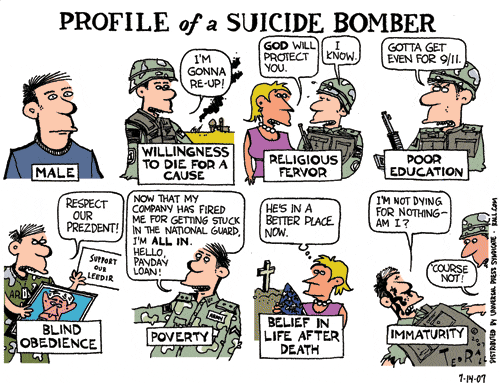
Ted Rall once again demonstrates the enlightened, tolerant, and progressive sensibilities of the Left.

I have no words adequate to describe the "what planet are you from?" mentality that puts forth such a clueless worldview.

Labels: , , , , ,

Friday, July 13, 2007

The Cut-n-Run Is Looking Ever More Likely

With our craven "re-election above all else" politicians growing ever more determined to ensure our defeat in Iraq regardless of the horrific consequences that would certainly follow, it's worth thinking about what our sudden withdrawal would actually mean. And this guy sums up the whole thing pretty well in a response to the latest surrender piece in the New York Times.

I'm getting awfully discouraged, gentle reader. The voices of defeat and surrender are louder and more reality-impaired than ever. I almost wish they'd get their way, just so that the inevitable disasters that would follow could unfold and discredit such empty ideas once and for all.

Labels: , , , ,

Wednesday, May 30, 2007

Useful Idiot Useful No Longer

Going back to a post from almost two years ago, I quote myself:

"I think Ms. Sheehan is going to discover that once her utility as a stalking horse is done with, none of these people currently flocking to her banner is going to remember who she was. They'll have MoveOn.org'ed to the next "George Bush is a poopie-head" story."

The moment has arrived. Ms. Sheehan, once the darling of the anti-war left, is now apparently persona non grata in that same community. She posted a farewell letter of sorts in her diary at Daily Kos.

Poor woman. She started from grief, motivated by the death of her son Casey, and quickly found herself in a world for which she wasn't prepared. The Right had always lambasted her for her antics (and to be honest, doing things like cavorting with Hugo Chavez did not help her cause) and now the Left is done with her. She is experiencing the disdain and outright hate that the outer fringe of the Left displays for all those who fall out of step with their agenda.

I hope she finds some sort of peace once the spotlight is off.

Labels: , , ,

Thursday, May 17, 2007

Perspective

Here's a quick graph to bring some much-needed perspective to the war in Iraq. This doesn't diminish the tragedy of the casualties over there, but it does show that things could be much, much worse.

Hat tip: Teflon at MoltenThought.

Labels: , , ,

Saturday, December 30, 2006

Farewell to Evil

Saddam Hussein no longer wastes the planet's oxygen. This is a good thing.

Saddam's victims ran into the tens of thousands at the very least. We'll probably never really know just how many innocents perished at his command.

Sic semper tyrannis.

Labels: , ,

Thursday, December 14, 2006

Can America Still Win Wars?

Not a rhetorical question. Do we, as a nation, have the will to win wars any more?

Since the VietNam War ended, we have recast our military into a supremely lethal and effective force. The US Military is superbly designed and equipped for the task of shredding opposing militaries with frightening speed and efficiency. It's no exaggeration to say that our current armed forces probably constitute the most effective military in human history.

But what that describes is a force that wins battles, not one that wins wars. It's not enough to destroy opposing military formations. To win, one must seize and hold the enemy's territory, destroy the will to resist, and build some form of government in the defeated nation which can then maintain order. The classic example is what was done at the end of World War II, when massive armies of occupation garrisoned the defeated Axis powers as civil authority was restored and the nations were turned from enemies into allies.

Iraq is not working out that way. We kicked apart Saddam's armies easily enough (relatively speaking, of course . . . the victory was "easy" only by comparison to previous conflicts). But the force we sent was too small to effectively garrison the country once we'd destroyed the existing authority. As the conventional wisdom has it, mistakes were made. Assumptions were overly optimistic.

Now, the press would have you believe that the situation in Iraq is an unmitigated disaster, with chaos around every corner and failure the only sure outcome. But the commanders on the ground there report that efforts are succeeding, by and large, to contain the insurgency and restore the ability of self-governance. It's going slowly, there are setbacks, but the trend is towards success.

And yet the American public is turning against the effort. We're deciding that the cost in blood and treasure is too great, and the momentum for the cut-and-run continues to grow. What's needed is a larger number of troops to control the situation, continued infusions of aid in rebuilding civilian infrastructure, and training for Iraqi police and military units so that they can assume the normal duties of such organizations. All of this is in short supply.

At the end of the Cold War in the early 90s, we made the classic post-war mistake of democracies: we drew down our military too far and too fast. The result is a force that is relatively small given the size of our country and the missions we ask it to perform. As I noted above, it's an astonishingly capable force, but for the job of capturing whole countries, it's simply too small. We can destroy enemy militaries, but we can't impose order on the nations we have defeated. We have a force that wins battles and loses wars.

This is a perfectly fine arrangement so long as the missions undertaken are things like the Gulf War, or defeating a North Korean invasion of South Korea. However, when you engage in what amounts to wholesale conquest (and let's not be coy, that's what we did in Iraq and Afghanistan) you need a very large number of foot soldiers so that you can effectively police the country you've conquered. Previous empires have done this by co-opting the conquered into becoming members of the empire and policing themselves. The US, which despite the claims of the reality-impaired is in no way an empire, prefers to simply destroy or otherwise mitigate threats and then engage other nations with primarily economic means. Basically, we want to sell them our stuff and we want to buy their stuff. We tie our "empire" together with trade and mutual profit, not with armies of occupation.

Then there's our media. In the last fifty years, the world has gone from a model in which a newspaper account a day or more after the fact was the primary source of news to a model of the instantaneous communication of multimedia presentations that's omnipresent and always on. If General Patton slapped a soldier today, it would be on CNN and Fox News by lunchtime at the latest, with a variety of talking heads second-guessing every aspect of the incident and telling the rest of us what to think about it.

There's a telling statistic out there - something over eighty percent of the American press supposedly votes Democrat every election. It's therefore difficult to believe that they can be "fair and balanced" when reporting on a Republican-dominated government. However, the main game for the press is "Gotcha!" This supercedes even the most virulent partisan impulses. Witness, for example, the unprecedented feeding frenzy surrounding the Bill Clinton / Monica Lewinski story. This seems to stem from the Watergate era, when the Washington Post led the way in bringing down President Nixon. The reporters directly involved (most famously Woodward and Bernstein) viewed this not only as an extraordinary bit of journalism but as a demonstration of the power of the press. If the press collectively decides it doesn't like a politician, the press feels not just allowed, but obliged to destroy that politician. Journalists have assumed a position of tremendous arrogance, deciding that they know what's best.

The twenty-four-hour news cycle is also destructive in that it presents instant, or nearly instant, feedback on all government actions, both civilian and military. Witness the cries during the invasion of Iraq that the whole thing was a failure when a sandstorm held up the coalition advance for a few hours. Quality of reporting is sublimated to speed of reporting - it's more important to report it right now than to report it right. Fox doesn't want CNN to beat them to a report, after all, so accuracy is sacrificed to immediacy. Corrections may appear after more information comes in, or more experts are able to provide analysis, but often the first impression is the lasting one.

Military personnel in Iraq are reportedly developing an extreme dislike of the press. This is due to the perception that the press is only reporting the bad news, exaggerating it at that, and not reporting positive developments. Indeed, in some cases (the "six Sunnis burned to death" story leaps to mind) the press is actually manufacturing stories from whole cloth. There was, and is, a huge controversy around the Associated Press publishing falsified photographs of incidents that either happened differently than alleged or didn't happen at all.

This is poison to the informed debate needed to sustain a democratic government.

Then there's the blogosphere. While on one hand offering an entirely new means of reporting and commentary, blogs also allow anyone, no matter how biased or deranged, to put forth their version of an event. One has only to consider the insane conspiracy theories about the 9/11 attacks to see the horrific potential of this. A non-trivial segment of the American populace supposedly believes that our own government is responsible for 9/11. This is madness.

Blogs on the left have been beating the anti-war drums loudly and continuously since it became apparent that President Bush was going to take military action in Iraq. Although it now seems clear enough that the war was launched on false pretenses, the left is not satisfied with this and campaigns tirelessly for a cut-and-run strategy that would have disastrous long-term consequences. In opposition, you have blogs on the right that seem willing to support or excuse any action on the part of the administration in the name of "patriotism." The long-term consequences of blind obedience, although different from those of the cut-and-run, are no less disastrous to western liberal democracy.

But the upshot of all these matters is the fostering of a climate which is corrosive to the sort of sustained national unity necessary to win a major war. There must naturally be debate about the course of the effort and what constitutes victory. This is so obvious that it shouldn't need to be said. But the ultimate long-term goal, that of the survival of liberal democracy, must not be lost in the short-term struggle for political position. The essential civil liberties that make America what it is must not be sacrificed on the altar of expediency. This is what makes things like the so-called Patriot Act so unpalatable to so many people. We suffer certain tactical disadvantages from having a society as open as ours is, but closing things up takes away our national soul one little piece at a time.

Fulcrum Ruminations does not pretend to be a news blog. This blog is not about reporting specific events. This blog is nothing more than the opinions of one person, reflecting on the issues of the day. And what I see emerging from the chaos of Iraq, gentle reader, is a future in which America can destroy an enemy with devastating speed but is unable to address the longer, much more difficult issue of preventing new enemies from gaining a toe-hold. We can bulldoze entire nations but we cannot stop the next generation from going right back to the same behaviours that led to the bulldozing. We know how to win battles. We do not have the patience to win wars. Not when half of our population is more interested in portraying the other half as evil or stupid than they are in assuring the long-term survival of the social order which makes the debate possible at all.

Labels: , , , , , , ,

Tuesday, October 10, 2006

A Little Economic News

Just briefly, it seems that Bush's economic policies are paying off (so to speak). One of the few things going right for this hapless administration.

Since it looks like the Republicans have adopted the Democrats' "watch us self destruct!" election playbook this year, it's likely that the Dems will take back at least the House this election. I personally expect both House and Senate to switch hands, given the Foley/Hastert meltdown, the successful media effort to portray the Iraq war as a lost cause, and the general malaise affecting the Republicans. This of course means that the Bush tax cuts will be undone, taxes will go up (because that's one of the unchanging ground truths of the Democratic Party - they like higher taxes. Only on "the rich" of course, but strangely it's always the middle class and small business that takes it in the shorts when the Dems get to pass their tax bills. But I digress), revenues will go down, spending will continue to spiral out of control and the deficit will balloon again. All of which will be blamed on Bush's "failed economic policies" once Bush is out of office.

History shows that lower taxes stimulate the economy, bringing increased revenue and sustained growth. But, as always, the reality-impaired are not interested in the lessons history has to teach, but in enacting their flawed theories. Really, how many more times does "higher taxes=poor economy" have to be proven before the lesson finally sinks in?

Labels: , , , , ,

Tuesday, August 23, 2005

Bread and Circuses, Texas Style

You'd have to have been living on the dark side of the moon to have avoided the Cindy Sheehan story. In a nutshell, Ms. Sheehan is a woman whose son Casey was killed in Iraq some months ago. Casey Sheehan was a soldier in the Army, and had in fact re-enlisted after completing his first tour. Ms. Sheehan, in quite understandable grief over the loss of her son, has gone to President Bush's home town of Crawford, Texas to demand a face-to-face meeting with the President. She says she wants Bush to explain why her son had to die.

In general I agree with and approve of Ms. Sheehan's effort. One of the rights we as Americans enjoy is the right to petition our government for redress of greivances. By going to Bush's home turf and demanding he account for himself, Ms. Sheehan is exercising a Constitutionally protected right. This is proper and just.

However, there are two major problems which also make it perfectly clear why Bush can not meet with her as she wants. First, this would set a terrible precedent. Every future President would face an endless stream of protesters demanding face-to-face meetings to account for whatever unpopular action they had committed. It would never end. And, to be perfectly blunt, Presidents have better things to do with their time than explain themselves to individual Americans every time someone decides they messed up. That's what press conferences and the Sunday talk shows are for. :-P

Secondly, the Make George Look Bad crowd has seized on Ms. Sheehan as a poster child. Everyone from loopy bloggers (Hi Ma!) to Michael Moore has jumped on this bandwagon. Ms. Sheehan's original purpose has gotten overwhelmed. It's no longer "Why did my son die?" it's "George Bush is a poopie-head!"

I think Ms. Sheehan is going to discover that once her utility as a stalking horse is done with, none of these people currently flocking to her banner is going to remember who she was. They'll have MoveOn.org'ed to the next "George Bush is a poopie-head" story.

There is also a backlash gaining traction against her. Her family has apparently distanced themselves from her, her husband either already has or is in the process of divorcing her, and the predictable "George is Our Saviour" crowd is rushing to the attack. There will be much ugliness before the story has run its course.

And all because Ms. Sheehan doesn't seem to understand that her son was engaged in a profession he found to be honorable and just.

The realpolitik of the situation is that we can't pull out of Iraq at this point. The country would dissolve into chaos and civil war, with a bloodbath that would make the last couple years look like a Boy Scout Jamboree. No Arab government or people would trust us again, the jihadists would have a major propaganda victory, and the terrorsts would be emboldened to strike at us even more ferociously. Pulling out before we're done would be the worst possible thing we could do. It would mean that Casey Sheehan really did die for nothing.

That's an unconscionable thing to do to a soldier.

Labels: , , , ,